B2B SAAS GO-TO-MARKET STRATEGY
FIN AI Agent Go-to-Market Growth Strategy
A go-to-market strategy for helping Fin win AI support adoption by proving resolution value inside the customer's existing support stack before asking them to rebuild it.
Independent portfolio strategy. The 11.75% model is illustrative and is not a reported Fin benchmark.
01 / Business Problem
AI support adoption has a commitment problem.
Support teams may believe in AI, but replacing or rebuilding their existing helpdesk introduces technical, operational, and organizational risk. The adoption barrier is not only product capability. It is commitment.
01
AI Interest
“We should automate more.”
02
Evaluation Friction
“Do we have to rebuild our stack?”
03
Implementation Risk
“Will this actually resolve enough?”
04
Buying Delay
“Let's wait.”
Strategic Response
Prove it before you rebuild.
02 / Market + Product Opportunity
The category is moving from AI curiosity to proof of resolution.
01
Support teams are under pressure to scale without scaling headcount.
AI becomes compelling when it can absorb repetitive resolution work rather than simply assist agents.
02
From “Does AI work?” to “Will it work for us?”
Proof, integration, and operational risk become go-to-market issues.
03
Fin creates a lower-commitment evaluation path.
It can compete alongside existing support systems rather than requiring immediate replacement.
03 / Competitive Landscape
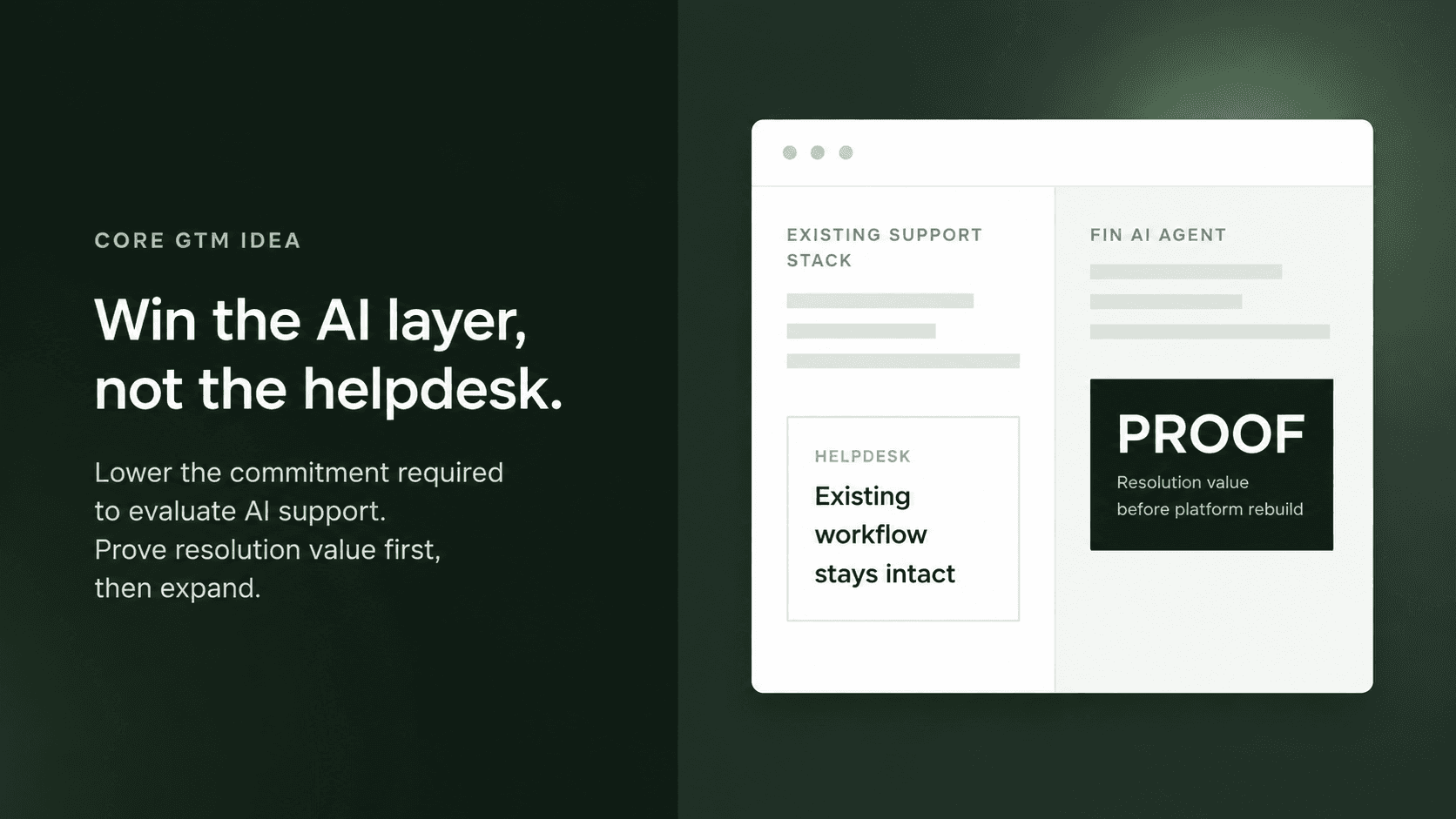
Fin does not need to win the helpdesk first.
AI resolution focus
LowHigh resolution / lower commitment
Incumbent Helpdesk + AI
Strong installed base, low switching appetite, AI layered into existing workflow.
AI-Native Support
Strong AI narrative with potentially higher organizational and platform commitment.
Fin
AI agent value that can be evaluated without requiring immediate helpdesk replacement.
Win the AI layer, not the helpdesk.
Secondary commercial pillar: Connect resolution to economics.
The goal is not to position Fin as simply cheaper. The goal is to show how AI resolution changes cost-to-serve.
04 / Who Should Fin Target?
Not every support team is equally ready for Fin.
High-fit companies are likely to have meaningful support volume, repetitive or resolvable tickets, existing helpdesk infrastructure, pressure to control support cost, enough knowledge content for AI, and willingness to test before rebuilding systems.
FIN FIT READINESS FRAMEWORK
Rising ticket volume · response pressure · growing support cost
Usable knowledge base · repeatable ticket categories · operational ownership
Executive pressure · budget or pilot capacity · internal champion
Illustrative High-Fit Account
A support team with pressure, proof potential, and a reason to act.
- Meaningful support volume
- Repetitive, resolvable ticket mix
- Existing helpdesk already in place
- Cost-to-serve pressure
- Knowledge content suitable for AI
- Champion willing to pilot
HIGH PAIN + HIGH AI READINESS + HIGH BUYING READINESS = HIGH-FIT FIN ACCOUNT
05 / Buyer + Buying Process + JTBD
One product. Multiple reasons to say yes.
Help me prove that AI can resolve meaningful support volume in my environment before I commit to rebuilding the way my team works.
06 / GTM + Acquisition
Build the funnel around proof, not hype.
01
Find
Reach accounts experiencing support pressure through paid search, LinkedIn, category content, competitive intent, and retargeting.
02
Educate
Show what AI resolution changes through economics, workflow, proof, and comparisons.
03
Evaluate
Reduce uncertainty with ROI tools, integration guidance, proof stories, demo content, and readiness assessment.
04
Activate
Move qualified accounts into a meaningful trial or pilot with first successful AI resolutions.
05
Convert
Translate operational proof into an economic case and commercial commitment.
AI customer support · AI support agent
Reduce support cost · scale support
Helpdesk AI · alternatives · integrations
07 / Content + Conversion Strategy
Every asset should answer the next buying question.
| Funnel Stage | Buyer Question | Content |
|---|---|---|
| Find | Why should I care? | Problem-led paid creative |
| Educate | What can AI actually resolve? | Educational content |
| Evaluate | Will this work in my stack? | Integrations + proof |
| Activate | How do I test it? | Demo / pilot / readiness |
| Convert | Is the economics case real? | ROI / resolution economics |
08 / Experimentation
Test the biggest GTM assumptions first.
01
Proof-led positioning
Hypothesis: “Prove it before you rebuild” will outperform generic AI-efficiency messaging for teams concerned about implementation risk.
TestProof message vs efficiency message
Primary KPIQualified landing-page conversion
02
Readiness-led conversion
Hypothesis: A readiness assessment reduces friction for accounts not yet ready to request a demo.
TestDirect demo CTA vs readiness assessment
Primary KPIQualified conversion / demo progression
03
Economics-led retargeting
Hypothesis: Resolution economics will perform better than generic AI messaging for evaluation-stage accounts.
TestROI/economics creative vs product-feature creative
Primary KPIEvaluation → activation rate
09 / Measurement + Business Model
Measure whether interest becomes proof.
Find
- CTR
- CPC
- Qualified account rate
Educate
- Engaged visits
- Content completion
- Return visits
Evaluate
- Demo conversion
- Readiness completion
- ROI-tool usage
Activate
- Pilot starts
- Successful resolutions
- Activation rate
Convert
- Pipeline
- Win rate
- Customer acquisition cost
Clicks indicate interest. Successful resolution proves value.
Illustrative Planning Model
11.75%
Illustrative modeled conversion. Not a Fin benchmark or reported result.
Model Logic
Use transparent stage assumptions so the model reads as a planning scenario rather than a performance claim.
- Scenario A (low) — 4% visit→evaluation · 25% eval→activation → 40 Activated Accounts
- Scenario B (mid) — 11.75% / 36.6% → 172 Activated Accounts → $581 CPA → 13 customers
- Scenario C (high) — 15% / 40% → 240 Activated Accounts → $417 CPA → 29 customers
10 / 30 / 60 / 90
How I'd take the strategy to market.
FIRST 30 DAYS
Instrument + Learn
- Validate account segments
- Finalize message hierarchy
- Build measurement baseline
- Create initial paid/content assets
- Launch core landing experience
DAYS 31–60
Test + Prove
- Launch acquisition tests
- Test proof-led positioning
- Activate retargeting
- Measure account quality
- Refine readiness framework
DAYS 61–90
Scale + Optimize
- Move budget toward strongest segments
- Scale winning messaging
- Deepen evaluation content
- Optimize activation path
- Build repeatable GTM playbook
11 / Limitations
Independent strategy, not Fin campaign results.
Scope
- Independent portfolio case study.
- Not commissioned by Intercom or Fin.
- Strategy based on publicly observable product and market information.
- No access to internal account, pipeline, campaign, customer, or unit-economics data.
- Campaign and conversion figures are illustrative planning models.
- Recommendations were not implemented or measured in a live Fin environment.
The strategy is designed to show how a specific adoption barrier can shape positioning, targeting, acquisition, proof, experimentation, measurement, and launch planning into one GTM system.